

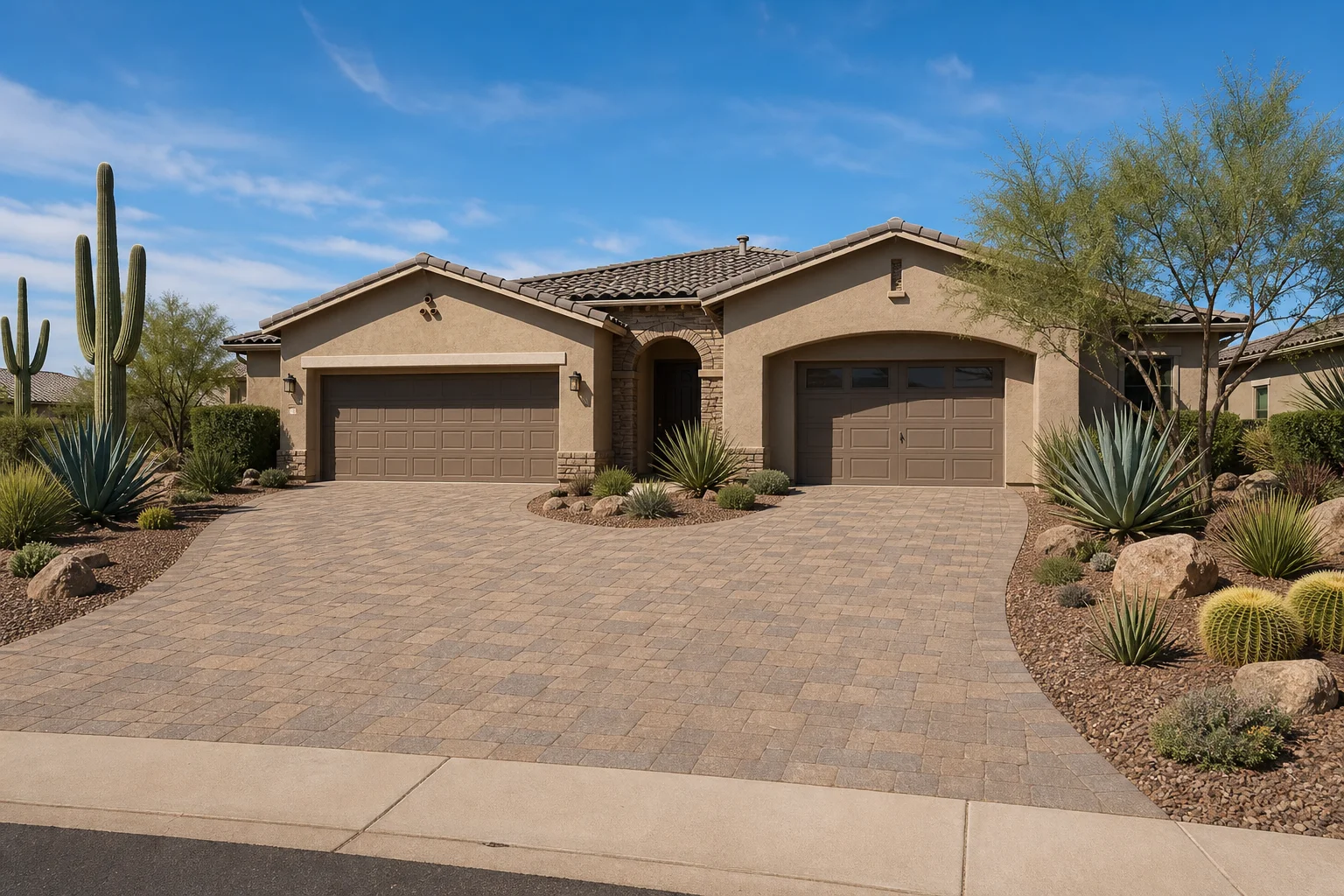
Paver driveway replacement in Arizona starts below the surface. Base depth, expansive soil, and drainage decide whether a driveway holds up for decades or cracks again within a few seasons. This guide covers the cost drivers, the installation timeline, and why pavers routinely outlast concrete once Tycho's Backyard Custom Construction services handle the excavation and base work.
By Tycho Solutions Team
How Deep Should the Paver Base Be for an Arizona Driveway?
A paver driveway is only as strong as what's underneath it. In Arizona, that base typically runs deeper than what a walkway or patio needs, because a driveway carries vehicle weight and constant thermal cycling. Contractors generally compact a layered aggregate base, often four to eight inches depending on soil conditions and load, then screed a thin bedding layer before setting the pavers. Skipping depth or compaction is the single most common reason a paver driveway installation fails early, well before the pavers themselves ever wear out. This is also where paver driveway replacement in Arizona differs most from a patch job: rebuilding the base under an existing driveway means correcting the drainage and compaction issues that caused the original failure, not just resurfacing over them.
What Does Paver Driveway Replacement in Arizona Cost?
There's no single number that applies to every property, because paver driveway replacement in Arizona is priced by what the job actually involves, not a flat rate per square foot. Homeowners searching for a driveway paver replacement quote should expect the estimate to break down each line item separately, since two similarly sized driveways can carry very different scopes underneath:
- Demolition and haul-away, if an old concrete driveway or old asphalt driveway is being removed rather than building on a bare dirt or gravel base.
- Base material and compaction, usually the largest labor component since it decides long-term stability more than any other step.
- Paver selection, driveway paver options in concrete, clay brick, or natural stone vary in unit cost and installation labor.
- Edge restraints and joint sand, including polymeric sand for driveways that need to resist ants and weed growth between joints.
- Drainage provisions, grading, channel drains, or permeable joints if the property has a low spot or the driveway pitches toward the home.
- Access and complexity, a driveway with tight side-yard access, a slope, or utility lines under the surface takes more labor than an open, flat pull-in.
Removing an old concrete driveway adds its own line, separate from installing the new surface, because breaking and hauling a slab is its own trade. The way to get an accurate number is a site walk: share photos of the current driveway and its square footage, note whether it's concrete or asphalt, and flag any drainage complaints so the quote reflects the actual scope, not an average.
Why Does Concrete Driveway Cracking Keep Coming Back in Arizona?
Concrete driveway cracking in Arizona is rarely a one-time event, because the underlying cause never gets fixed by a patch. Arizona's clay-heavy soils expand when they take on moisture and contract hard during long dry stretches, and that seasonal swing puts constant stress on a rigid concrete slab. A slab has no give, so once a crack starts, it becomes the path of least resistance every time the ground shifts again. Surface sealants and crack fillers address what's visible, not the soil movement underneath, which is why the same crack, or one nearby, tends to reopen within a year or two. This is the core argument for driveway replacement over another repair: a jointed paver surface is built to flex with the base instead of fighting it.
Pavers vs Concrete: Which Holds Up Better on Arizona Driveways?
Concrete pavers and poured concrete start from different assumptions about how a driveway should handle movement. A concrete slab is one continuous piece, so any settling, root intrusion, or soil expansion has to crack it somewhere to release the stress. A paver driveway is made of individual units set in sand over a compacted base, so the joints between pavers absorb minor shifts without a visible crack. If a section does settle, that area of paver driveway can be lifted, the base corrected, and the same pavers reset, something that isn't possible with a poured slab. Pavers provide a repairable surface that concrete simply can't match. Asphalt splits the difference: it flexes better than concrete but softens and ruts under Arizona summer heat, and it doesn't hold up as well long-term in high-traffic areas like a daily-use driveway. Beyond durability, a paver driveway typically adds more property value and curb appeal than a plain concrete slab, since the material and pattern options read as an upgrade rather than a repair.
What Are the Signs Your Driveway Needs Replacing, Not Just Repair?
A few patterns point toward replacement instead of another repair. Cracks that return in the same spot after being filled usually mean the base has failed, not just the surface. Pooling water near the garage or home's foundation after rain is a drainage problem that patching won't solve. Sunken or uneven sections, especially near where the driveway meets the garage slab, usually indicate the base has settled or eroded underneath. And a driveway that's been patched more than once in the same area is a sign the underlying issue was never actually addressed, which is usually the point homeowners decide to replace rather than repair again. When two or more of these show up together, paver driveway replacement in Arizona is typically the more cost-effective path than continuing to chase the same crack every year or two.
Can Pavers Be Installed Directly Over an Existing Concrete Driveway?
In most cases, no. A paver driveway installation depends on a properly compacted aggregate base underneath the pavers, and an old concrete driveway sits on top of the soil, not embedded in a base built for that purpose. Installing pavers directly over concrete usually just relocates the same drainage and cracking problems to a new surface, and it removes the ability to correct grading or fix a low spot that was causing water to pool. The more reliable process is removing the existing slab, building a proper base to the right depth and compaction for the property, and then setting the pavers on top of that. Tycho's Backyard in Mesa, AZ crews handle this removal-and-rebuild sequence often, since older Mesa-area homes are more likely to still have an original concrete driveway from the home's first pour. It takes an extra step, but it's the difference between a driveway that lasts and one that repeats the same failure with new material on top.
Will Expansive Soil in Arizona Cause Pavers to Shift Like It Does Concrete?
Expansive soil is exactly why the base matters more than the pavers themselves. A properly built base, compacted aggregate with the right drainage slope, absorbs and redistributes the soil's seasonal movement instead of transferring it straight into a rigid surface. Because a paver driveway is segmented into individual units rather than one continuous slab, minor base movement usually shows up as a slight, correctable shift in a joint rather than a crack across the whole surface. If a section does move more than expected, typically where drainage wasn't accounted for, that area can be pulled up, the base regraded, and the pavers reset without touching the rest of the driveway. That's a repair concrete simply can't offer once it has cracked.
Frequently Asked Questions
How long does a paver driveway installation take?
Most paver driveway installation projects take several days to about a week and a half, depending on square footage, whether an old concrete driveway needs to be removed first, and how much base correction the property needs. Demolition and base work usually take longer than laying the pavers themselves. Weather and site access can add time, so an accurate timeline comes from a site walk rather than a general rule of thumb.
How long do paver driveways last in Arizona heat?
Paver driveways generally hold up well in Arizona's heat and UV exposure, since the material doesn't soften the way asphalt can, and a properly built base means the surface isn't relying on one continuous slab to resist cracking. With a solid base and routine maintenance, a paver driveway is usually considered a long-term investment rather than something that needs replacing again within a few years, though individual results depend on soil conditions and drainage on the property.
Do paver driveways need sealing in Arizona, and how often?
Sealing isn't required for a paver driveway to function, but many homeowners choose to seal for color retention, easier maintenance, and added resistance to stains and weed growth in the joints. How often depends on the sealant product, sun exposure, and traffic, so this is usually a maintenance conversation with whoever installed the driveway rather than a fixed schedule.
How much does it cost to remove and haul away an old concrete driveway?
Demolition and haul-away is priced separately from the new installation because it's its own scope: slab thickness, whether the concrete has rebar or wire mesh, equipment access, and disposal or recycling fees all factor in. A driveway that's easy to reach with equipment costs less to remove than one behind a gate or down a narrow side yard. The only way to get an accurate number is a site assessment, not an estimate based on square footage alone.
Start Your Paver Driveway Replacement in Arizona
If cracks keep coming back or the driveway's showing its age, a site walk is the fastest way to get real numbers instead of guesses. Tycho provides a written scope before anything gets scheduled, so Get a Free Estimate and walk through the base, drainage, and surface options before work begins.